Roi-AI
B2B SaaS
UX Research & Synthesis
Data-Heavy Interface Design
Complex Workflows
Decision-Support UX




At a glance
Stakeholder endorsement
Design adoption intent
Reduced ambiguity
Clear handoff artefacts
Strategic clarity
role
Co-lead UI/UX designer
User research
Decision flows
Wireframing
Interactive prototyping
Results
Translated a technical, domain-specific brief into clear user flows and a coherent interaction model
Delivered implementation-ready design assets aligned with stakeholder priorities
Timeline
4 weeks
Sep–Oct 2025
As hiring data scales faster than the tools built to manage it, recruiters are left with valuable candidates and contacts trapped in underutilised, dormant systems.
The problem: Recruiters need access to the most up-to-date information about their candidates and clients, but waste time and lose confidence constantly cleaning and reconciling data across systems. They need a headache-free solution to quickly review and confirm:
profile syncs between their database and external enrichment sources,
duplicate records within their database, and
potential links between candidate and contact profiles.
The solution: a single queue that centralises all uncertain matches – duplicates, external syncs, and candidate–contact links – giving recruiters full visibility and control without chaos.
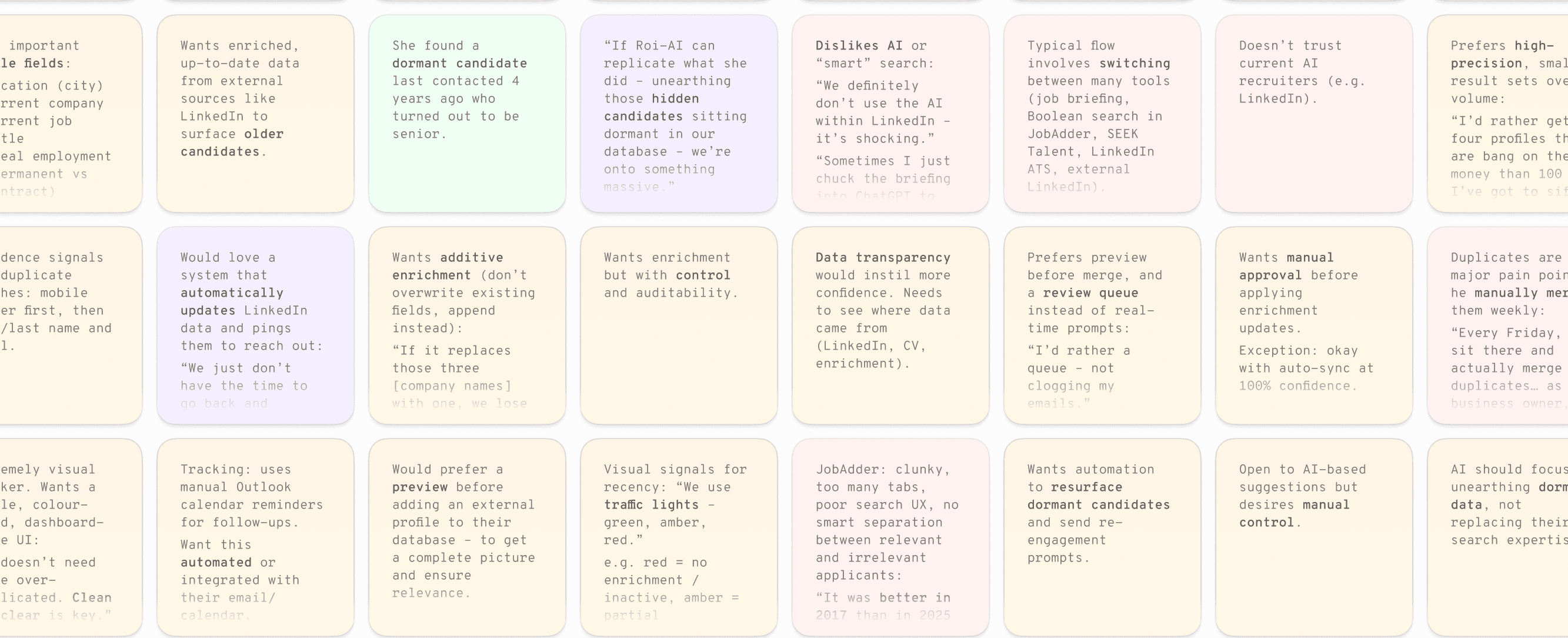
We spoke to a number of Roi-AI users within the recruitment industry to better understand their needs, motivations and frustrations. We asked open-ended questions about their experience with the current product as well as about their workflows as a whole. From our conversations, some common themes emerged:



“I’d want to see the enrichment first – preview it, don’t just replace what’s there.”
“Ask for approval first… I don’t want the company tag overwritten – we need to keep their history.”
“I’d rather preview them first, just to make sure it’s not merging the wrong people.”
“Give us a way to check everything in one place, not have it popping up all over the system.”
“I’d rather a queue – I don’t want it clogging my emails.”
“Every Friday, I sit there and merge duplicates with a beer. As a business owner, I shouldn’t be doing that.”
“It doesn’t need to be over-complicated. Clean and clear is key.”
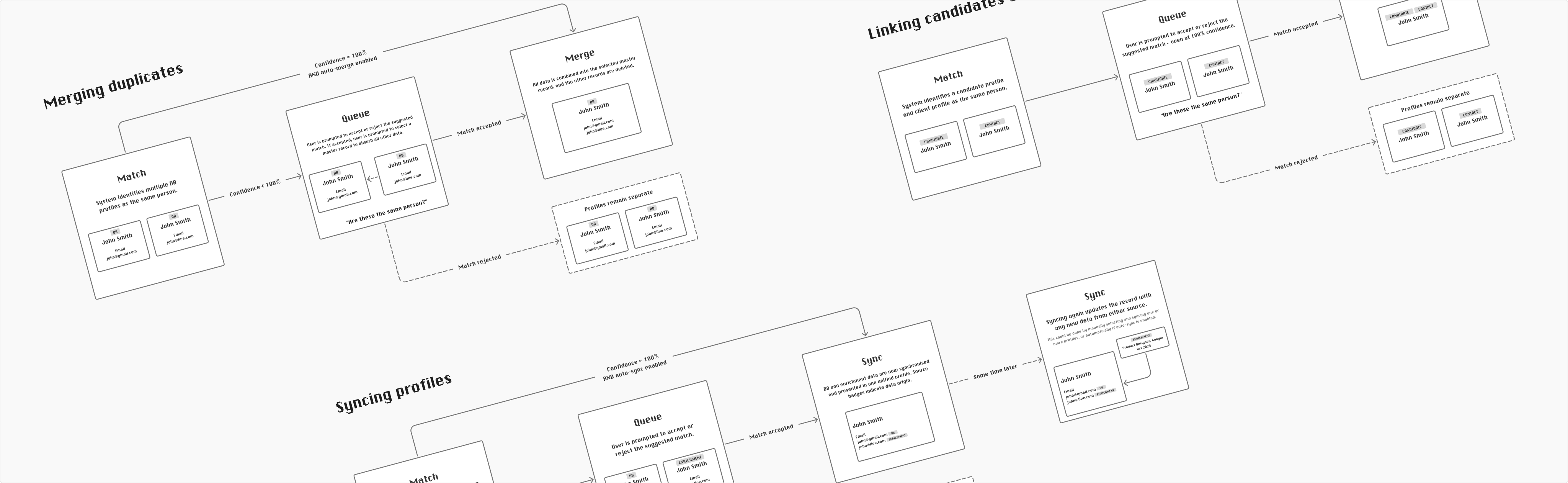
The challenge was to translate the technical specifications of ai.nstein’s functionality into a series of human-in-the-loop flows that would be both intelligible and useful to recruiters spanning a range of technical proficiencies. The diagram below outlines the overarching logic of ai.nstein's matching process. This core decision model is applied across three use cases, each resolving identity ambiguity in a different way: syncing profiles, merging duplicates and linking candidates to contacts.
Design
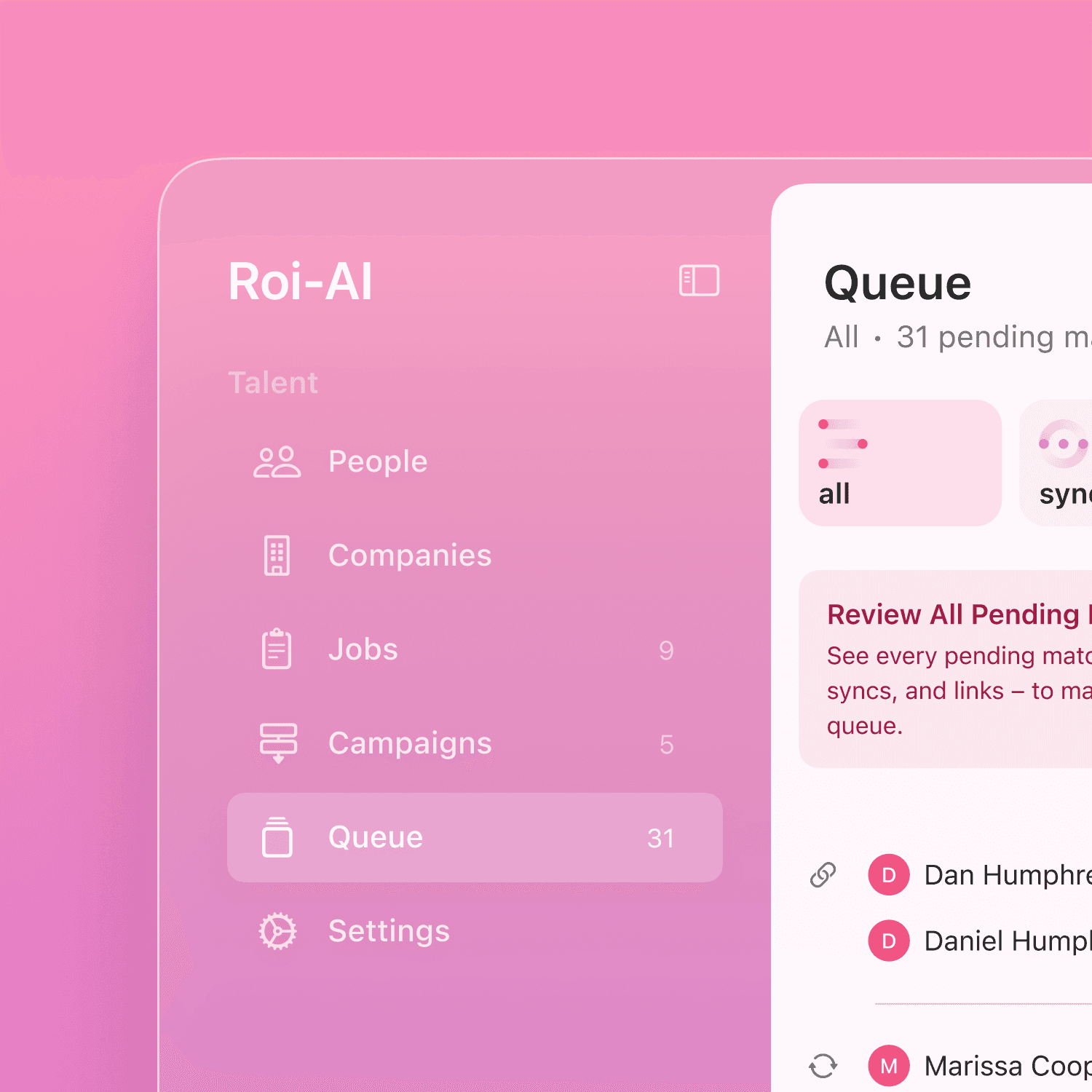
Dedicated Queue Tab
The queue can be opened from the sidebar when needed, aligning with users' preference for a focused, asynchronous experience.
Match Filtering
Recruiters can view all pending syncs, duplicates and links that require their approval, or easily filter out just one type of match.
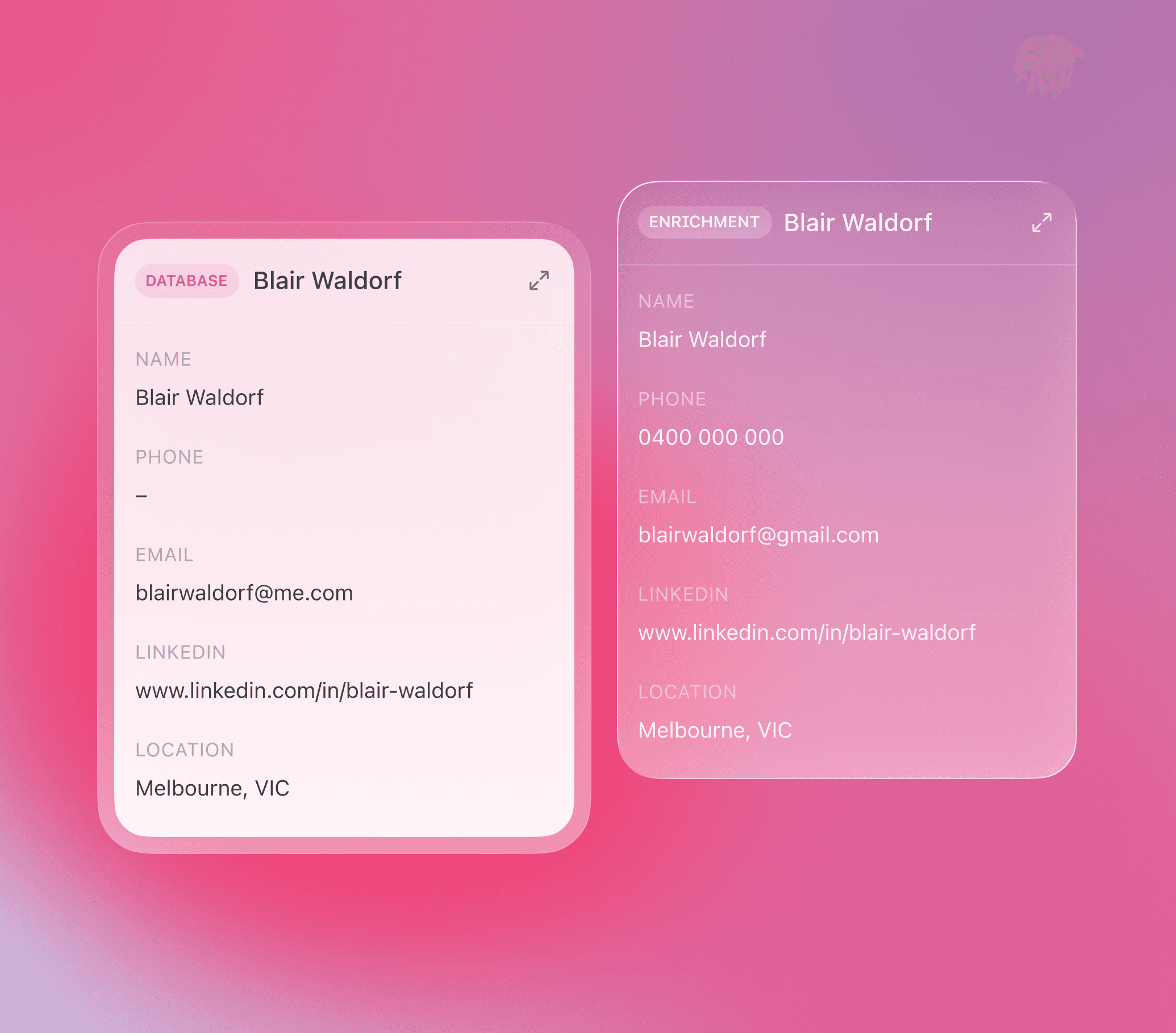
Card-Based Profile Matching
A pending match is represented by two profile cards – one containing the user's current database profile, and the other containing the corresponding enrichment data for the user to action. These cards intuitively display all relevant match data and enable selection-based control over proposed syncs, merges and links.
Fine-Tuned Sync Controls
To give recruiters as much control as possible while still keeping the interface streamlined, I implemented simple contextual actions to control the sync. When dealing with minimal or outdated data, users may opt for a full refresh by overwriting all data, or they may supplement their existing data by appending new data.
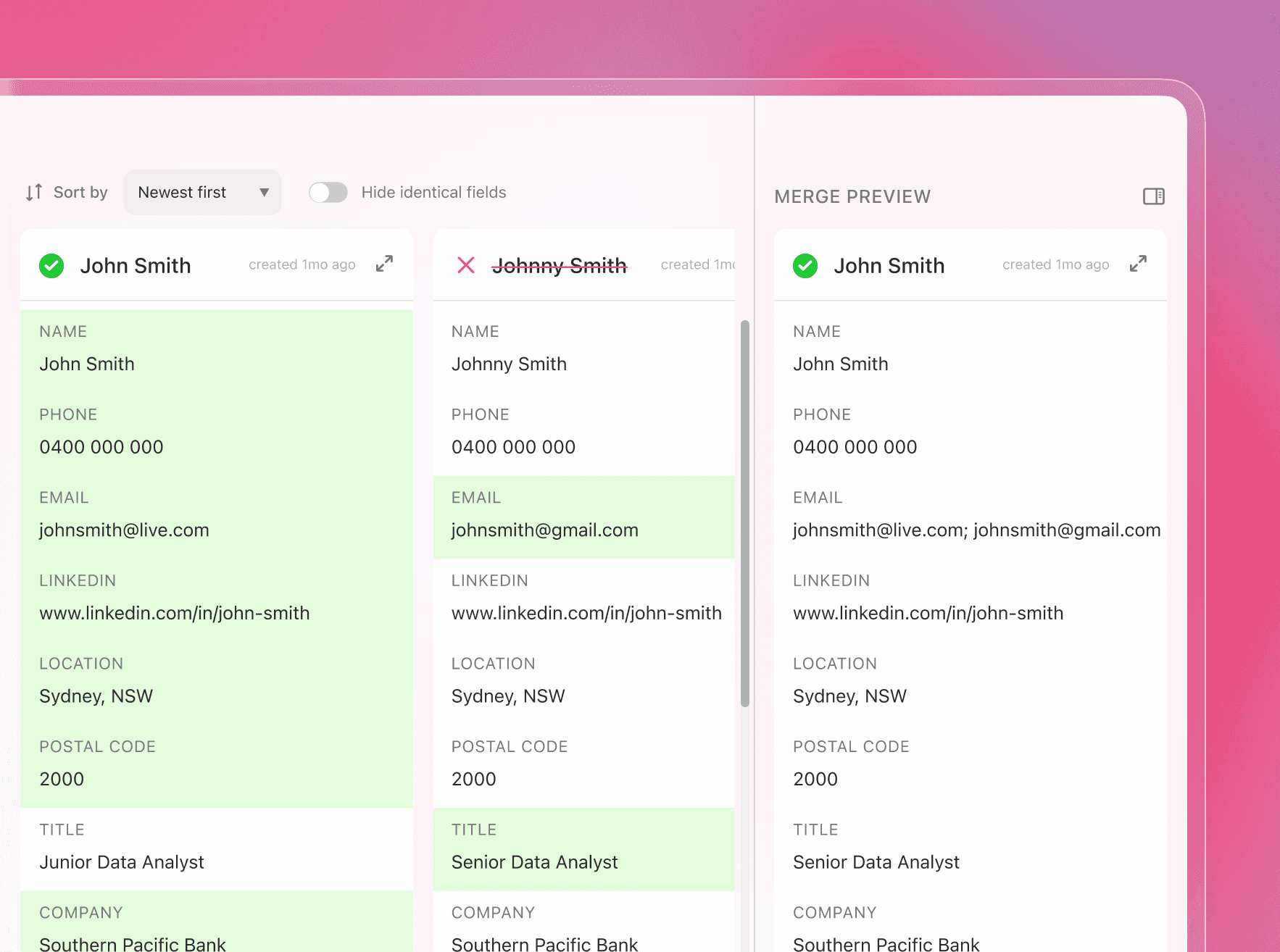
Fine-Tuned Merge Controls
Granular field-level data can be included or excluded from profile merges, ensuring data quality remains high and under user control when necessary.
Reflection
Next steps
While the current design prioritises transparency in the matching process, it could be strengthened by amplifying and spotlighting match confidence explicitly. A next iteration would explore clearer ways to communicate the likelihood that a proposed match is valid, such as a confidence score. This would provide a more instant, albeit one-dimensional, signal of match strength, allowing recruiters to make quick decisions in high-volume scenarios where processing speed matters more than fine-grained evaluation.
Testimonials

Chris South
Co-Founder & CEO, Roi-AI
© 2026 Joseph Cholakyan